
<p><strong>Heritage</strong></p>
Yeste, a town located in the Segura River valley on the slopes of the San Bartolomé hill, surrounded by a landscape of singular beauty, is a town divided into hamlets. A large number of hamlets provide great wealth to Yeste, hamlets that live exclusively from the fields, timber, agriculture, and livestock. The urban center, on the other hand, bases its economy on several more sectors. Within this urban center of Yeste, there are two distinct neighborhoods: the San Juan neighborhood and the Santiago neighborhood.
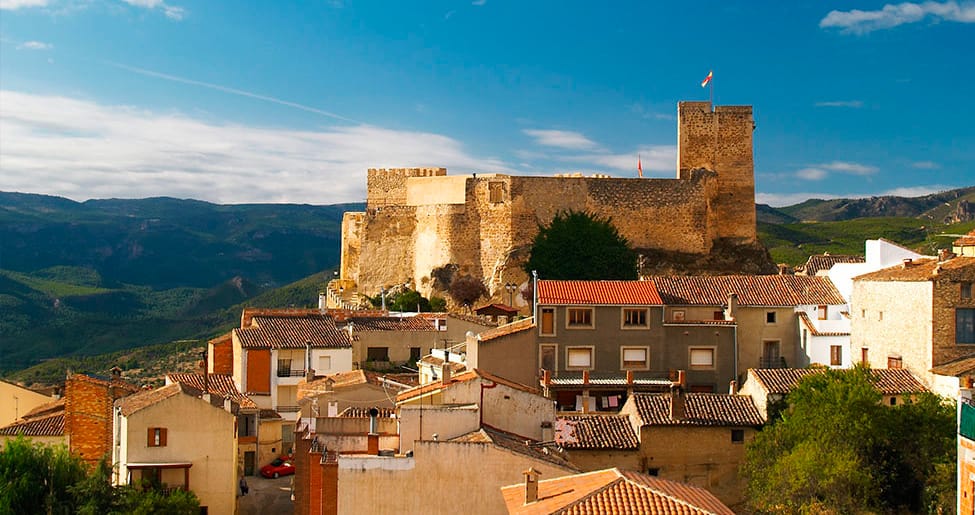
Yeste is a very peaceful town that boasts very old streets, such as Guerreros, with traditional architecture, narrow and interlaced streets, whitewashed facades, and manor houses that reveal its great historical influence. There are houses with large balconies and windows, some with the family coat of arms on the facade. Beautiful alleys are decorated with flowerpots, such as geraniums, basil, rosebushes, etc. Although new constructions can be seen in the central area of the town that are not very consistent with the traditional style, it is in itself a town with exemplary architecture of a rural area.
The medieval importance of the Villa de Yeste is reflected in a multitude of monuments and places of interest included within the urban center. Of all of them, the robust and well-preserved Castle and the Parish Church of the Assumption stand out as mandatory reference points. The Castle is located on a hill in the center of the town; its construction dates back to the 13th century. It subsequently underwent certain modifications that eventually gave it the appearance we can see today. Despite its age, it is the best-preserved of all those in the Sierra del Segura.
The Church of the Assumption has been declared a Heritage of Cultural Interest. It is a 16th-century temple in which Gothic and Renaissance styles are combined. Inside this temple, we find a carving of the Dolorosa, a work attributed to Francisco Salzillo. Made of polychrome wood using the estofado technique, it suffered damage in 1936 and was later restored. Other monuments are scattered throughout the urban center of Yeste, such as the Hermitage of Santiago (16th century), the Private Chapel of Don Martín Pérez de Ayala, and the Town Hall building of Renaissance design. Cava and Guerreros streets are essential for a walk, as the renowned Casa del Vicario is located in the former; in Guerreros street, we find houses that are preserved with their original stately structure and lintelled courtyards. In the surroundings of Yeste, we can enjoy a swim in the Fuensanta Reservoir or the Tus Spa, in the river of the same name.